The Otterhound has fascinated for centuries with its rustic appearance and its past as an otter hunter. Originating from the moors of the United Kingdom, it stands out with its robust silhouette, coarse fur, and exceptional sense of smell. Today, this four-legged companion has become extremely rare, favored by a few passionate breeders and lovers of ancestral lineages. Let’s dive into the world of this uniquely charming dog.
🦠 Millenary origin: born in the heart of Kent, this English breed specialized in tracking otters thanks to an overdeveloped sense of smell.
🐾 Massive physique: 65 to 80 cm at the withers, weight between 36 and 50 kg, muscular build and dense waterproof coat.
❤️ Sociable temperament: affectionate, energetic, loyal, it thrives in a family but requires daily physical activity.
⚕️ Proven rarity: fewer than 600 worldwide births per year, strict health monitoring and genetic preservation programs.
History and origin of the Otterhound
Like many British hunting dogs, the Otterhound traces its origins to crosses between hounds and European griffons in the 14th century. Records from Kent nobility already mention its participation in royal otter hunts, then considered harmful to fishing and agriculture.
The modern breed standard is often attributed to Lord Medway who, in the 19th century, centralized the stock to obtain a more powerful and enduring dog. Its name, literally “otter dog,” comes from the intensive use of its nose to track these aquatic mammals even into their submerged dens.
“The Otterhound is not just a simple hunting dog; it is a living heir of the English moors, endowed with an olfactory memory worthy of the finest bloodhounds.”
John Turner, canine historian, University of Southampton – 2018
Morphology and physical characteristics
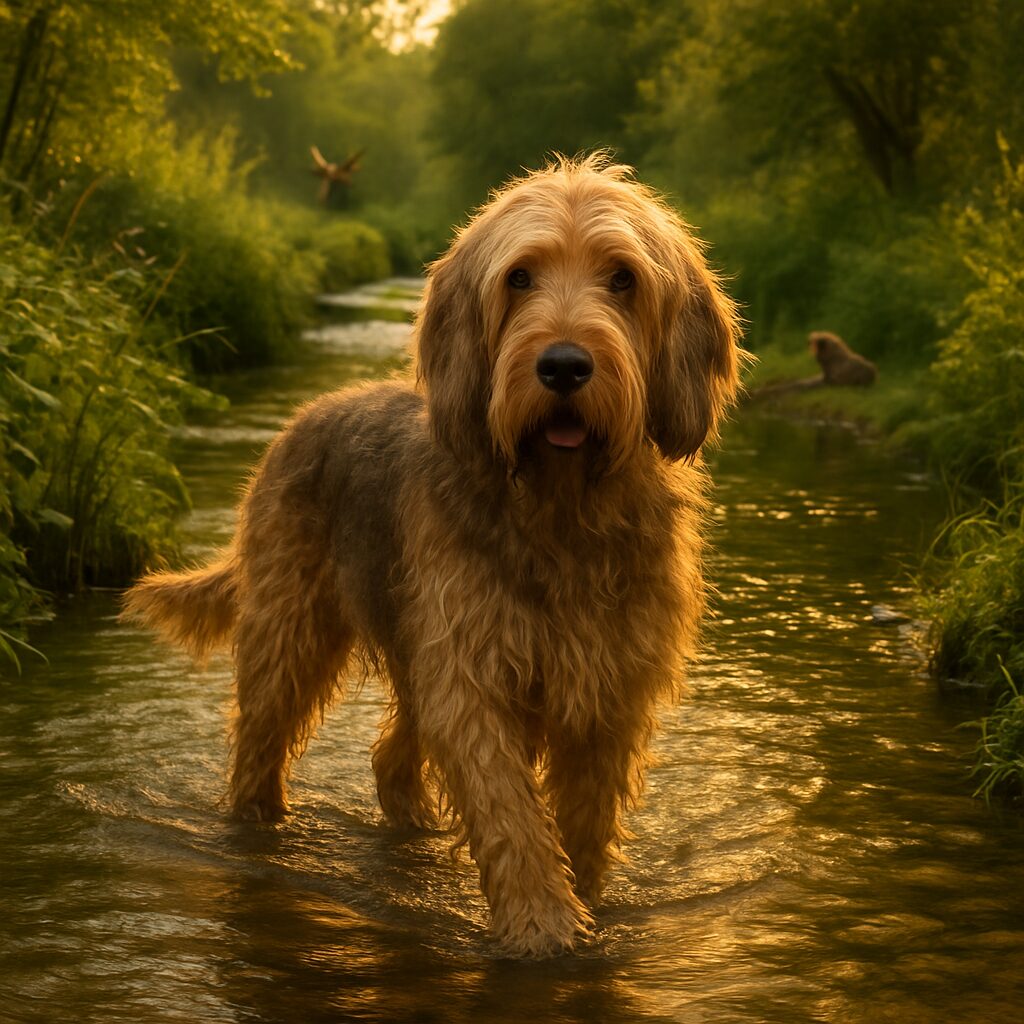
If you encounter an Otterhound, you will be struck by its wingspan. Every element of its anatomy serves a precise function: powerful jaws to extract prey, webbed feet to swim efficiently, thick fur designed to resist cold and moisture.
| Characteristic | Males | Females |
|---|---|---|
| Height at withers | 68–80 cm | 65–75 cm |
| Average weight | 40–50 kg | 36–45 kg |
| Coat | Rough, dense, waterproof (gray, black, brown) | |
| Life expectancy | 10–12 years | |
The Otterhound’s eyes, almond-shaped and often dark, reflect a gentle and contemplative character, while its drooping ears require regular care to avoid infections and knots.
Temperament and Behavioral Needs
With behavior close to that of a freedom-loving teenager, the Otterhound combines insatiable curiosity and natural sociability. He loves human contact, bonds with children and peers, and rejects isolation.
- Energy: moderate to high level, ideal for sustained walks or canine activities.
- Independence: tendency to follow his nose, requires a strong recall.
- Sociability: gets along with most animals, but early contact is recommended.
- Intelligence: lively, learns quickly, but can get bored with repetitive exercises.
“At the heart of the Otterhound’s behavior, one detects an almost scientific curiosity, a desire to solve each new obstacle through exploration.”
Dr. Emily Watson, canine ethologist, Royal Veterinary College – 2021
Recommended Activities
His aquatic robustness makes him an excellent companion for cani-rafting or riverside hikes. Also consider tracking and scent games, true revealers of his natural potential.
Socialization and Education
The key lies in an early start: playful sessions, varied rewards, and exposure to diverse environments ensure lasting emotional balance.
Health and Longevity
Despite his solid constitution, the Otterhound has certain genetic predispositions: hip dysplasia, entropion, chronic ear infections. Biannual veterinary check-ups and regular dental care are essential.
- Vaccinations: according to local veterinary protocol (rabies, hepatitis, leptospirosis).
- Ear monitoring: weekly cleaning to prevent infections.
- Orthopedic control: annual X-rays from 2 years old.
- Nutrition: balanced diet rich in proteins and essential fatty acids for skin and coat.
A 2020 study (Martin et al., Journal of Canine Health) showed that regular physical activity reduces orthopedic risks by 25% in large breeds, including the Otterhound.
Breeding and Rarity: A Contemporary Challenge
Today, the breed counts fewer than 600 annual births worldwide, mainly concentrated in the United Kingdom, the United States, and France. The limited numbers lead to carefully planned breeding programs to avoid inbreeding.
| Country | Number of litters | Registered breeders |
|---|---|---|
| United Kingdom | 200 | 45 |
| United States | 150 | 30 |
| France | 80 | 15 |
Obtaining an Otterhound puppy often involves a long waiting list, thorough interviews, and signing a follow-up contract to ensure the well-being of the lines.
Practical Advice for Future Owners
Before falling for the endearing face of the Otterhound, consider:
- Space: fenced garden essential, access to water a plus.
- Time: at least 1 hour of daily activity.
- Budget: veterinary fees, grooming, and specific food.
- Commitment: lifelong behavioral monitoring and socialization.
An active, loving home ready to devote time to education will offer your Otterhound an environment in which he will fully flourish.
FAQ – Frequently Asked Questions
- What is the Otterhound’s temperament?
Docile, affectionate, but sometimes stubborn if poorly stimulated. - Is it suitable for beginners?
Rather not: its size and energy require an experienced owner. - Can it live in an apartment?
No, space and regular outings are essential. - What is its average price?
Between €1,200 and €1,800, depending on pedigree and country. - What is its lifespan?
About 10–12 years under veterinary supervision. - Coat maintenance?
Weekly brushing, baths adapted to its rough coat. - Allergies?
Unlikely, but beware of chronic ear infections. - Puppy or adult?
The puppy allows complete socialization, the adult is already balanced.