
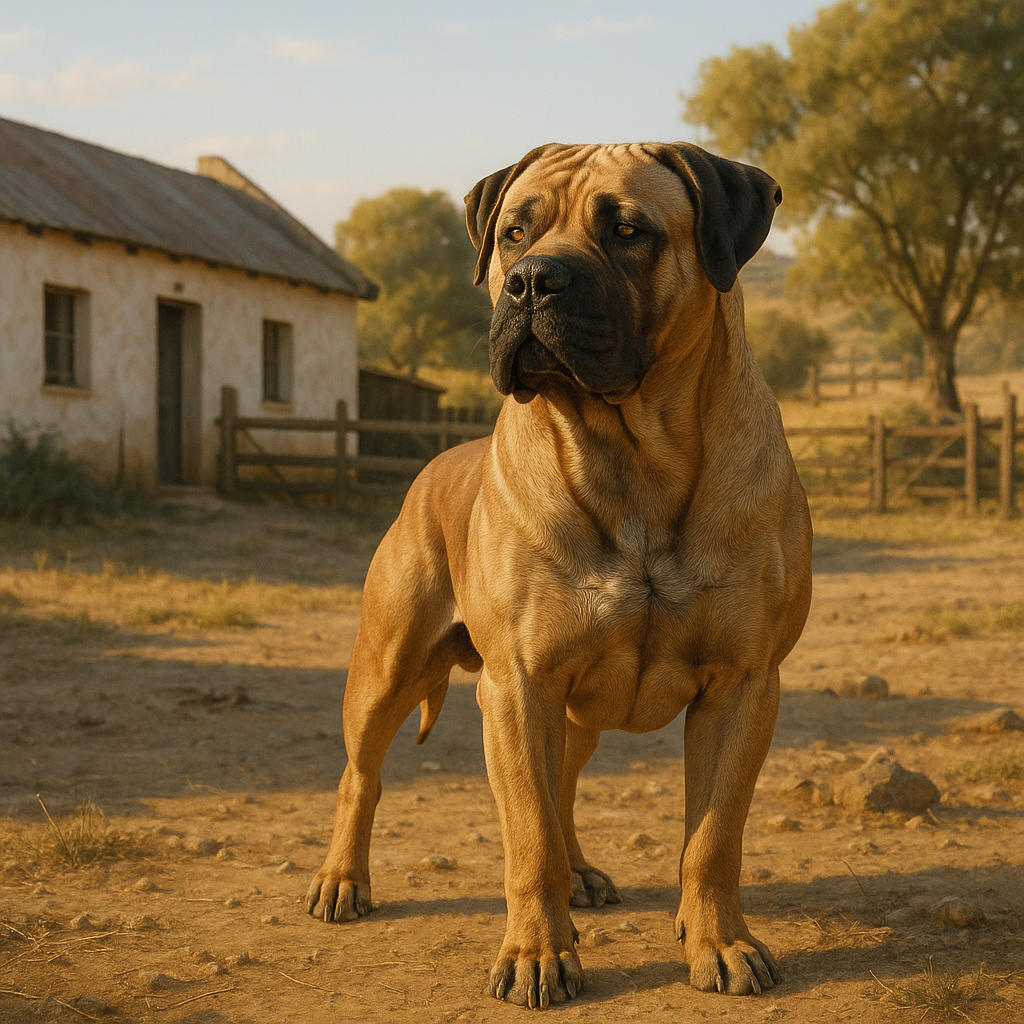
Imposing, vigilant, and fundamentally unwaveringly loyal, the Boerboel impresses at first glance. Born on South African farms, it forged its reputation among Boer settlers as a guard dog capable of deterring even the most daring intruders. But behind this sometimes intimidating build lies an endearing companion, sensitive to those around him. Let’s explore together his history, character, and everything you need to know to live in harmony with this extraordinary molosser.
In Brief
🛡️ Rural Origin: developed on South African farms to guard livestock and property, the Boerboel combines robustness and adaptability.
❤️ Protective Temperament: unwaveringly faithful, this dog forms a strong bond with its family while showing natural vigilance.
🏋️ Exercise Needs: active and powerful, it requires daily walks and mental stimulation activities to thrive.
⚕️ Robust Health: lifespan of 9 to 11 years, moderate predispositions to dysplasias; a balanced diet and regular check-ups are essential.
Origins and History of the Boerboel
Genesis on South African Farms
In the 18th and 19th centuries, Boer pioneers imported European molossers to create a guard dog capable of protecting their lands and loved ones. English mastiffs, bulldogs, and local dogs were crossed: from these unions gradually emerged the Boerboel (literally “farm dog” in Afrikaans). Its rustic morphology, endurance, and balanced temperament quickly designated it as the ideal sentinel against predators and thieves.
Evolution and Recognition of the Breed
Throughout the 20th century, South African breeders refined the standard, favoring a massive but functional build without exaggerating size. In 1983, the South African Boerboel Breeders’ Society laid the first official foundations; twenty years later, several international federations recognized the breed. Even today, this dog symbolizes the pride and resilience of Southern African farmers.
Character and Temperament
Protective and Loyal
More than just a guardian, the Boerboel develops a very special chemistry with its human pack. It is deeply attached to its family and does not hesitate to be determined when it perceives a threat. This reassuring aura is coupled with sharp intelligence: it quickly learns to distinguish what represents a danger from what is part of everyday life.
- Constant Vigilance: always alert, even at rest.
- Calm Under Pressure: knows how to control itself until a real provocation occurs.
- Sense of Hierarchy: respects a clear pack leader.
- Controlled Independence: obedient but not servile.
Relations with Family and Children
Surprisingly gentle with the youngest, this mastiff knows how to modulate his strength to play without roughness. He is an excellent companion for well-behaved children, provided they are taught to respect canine rules. Like the bullmastiff, another guardian mastiff, he is docile as long as his training remains consistent and positive.

Care and Needs
Exercise and Mental Stimulation
The Boerboel is not a fan of long hours of activity: he prefers intense and brief activities. One hour of dynamic walking, punctuated by tug-of-war or obedience games, is enough to channel his energy. Intelligence games (hide-and-seek with treats, simplified agility courses) will occupy his mind while strengthening your bond.
Feeding and Veterinary Care
His massive build requires a diet rich in quality proteins, moderate in carbohydrates. It is recommended to split meals to avoid stomach torsions. Semi-annual orthopedic check-ups, including X-rays of hips and elbows, help detect any dysplasia early.
Health and Longevity
Genetic Predispositions
The Boerboel generally enjoys good health, with a life expectancy ranging between 9 and 11 years. However, two points of caution stand out:
- Hip and elbow dysplasia: moderate prevalence, to be monitored from weaning.
- Cardiomyopathy: preventive cardiac exams starting at 3 years old.
“Rigorous veterinary follow-up, combined with an adapted exercise program, guarantees the longevity and well-being of the Boerboel.” – Dr. Sarah Van der Merwe, canine specialist veterinarian.
Prevention of Common Diseases
Up-to-date vaccinations, quarterly deworming, and weekly brushing of the thick coat are the pillars of good prevention. An annual dental check-up is essential to avoid gingivitis, quite common in this breed.
Training and Socialization
Practical Training Tips
Always firm but never harsh, the trainer must use positive reinforcement: rewards and verbal praise quickly strengthen good behaviors. Short sessions (10–15 minutes) conducted from a young age ensure better concentration.
Mistakes to Avoid
- Never resort to physical or verbal violence, which causes lasting distrust.
- Avoid prolonged isolation: a naturally sociable dog can develop anxiety.
- Do not neglect basic obedience training (sit, lie down, recall).
Adopting a Boerboel: What You Need to Know
- Breeder or shelter? Favor a recognized breeder, member of a national canine club.
- Annual budget: between €1,500 and €2,500 (food, care, accessories).
- Time available: daily presence and regular outings are essential.
- Environment: a secure garden is highly recommended.
Ideal Environment and Compatibility
Living in a House vs. Apartment
It is better to avoid apartments: the Boerboel thrives in an outdoor space where he can expend his energy. A fenced garden of 1,500 m² or more ensures his physical and mental well-being.
Compatibility with Other Animals
Well socialized from a young age, it can live with dogs and cats. However, its territorial nature requires a gradual and controlled introduction, especially when faced with small feathered animals or rodents.
FAQ
What size does an adult Boerboel reach?
Males generally measure between 63 and 70 cm at the withers, while females are around 60 to 66 cm.
Is the Boerboel suitable for families with children?
Yes, it is a protective and patient companion, provided that interactions are supervised to ensure safety and mutual respect.
What is the average lifespan?
Expect between 9 and 11 years, provided there is good nutrition and regular veterinary care.
How much exercise per day?
About 60 minutes of dynamic activity, complemented by intelligence games to stimulate its mind.
Where to find a reputable breeder?
Contact a national club or a recognized breed association to ensure traceability and adherence to the standard.