
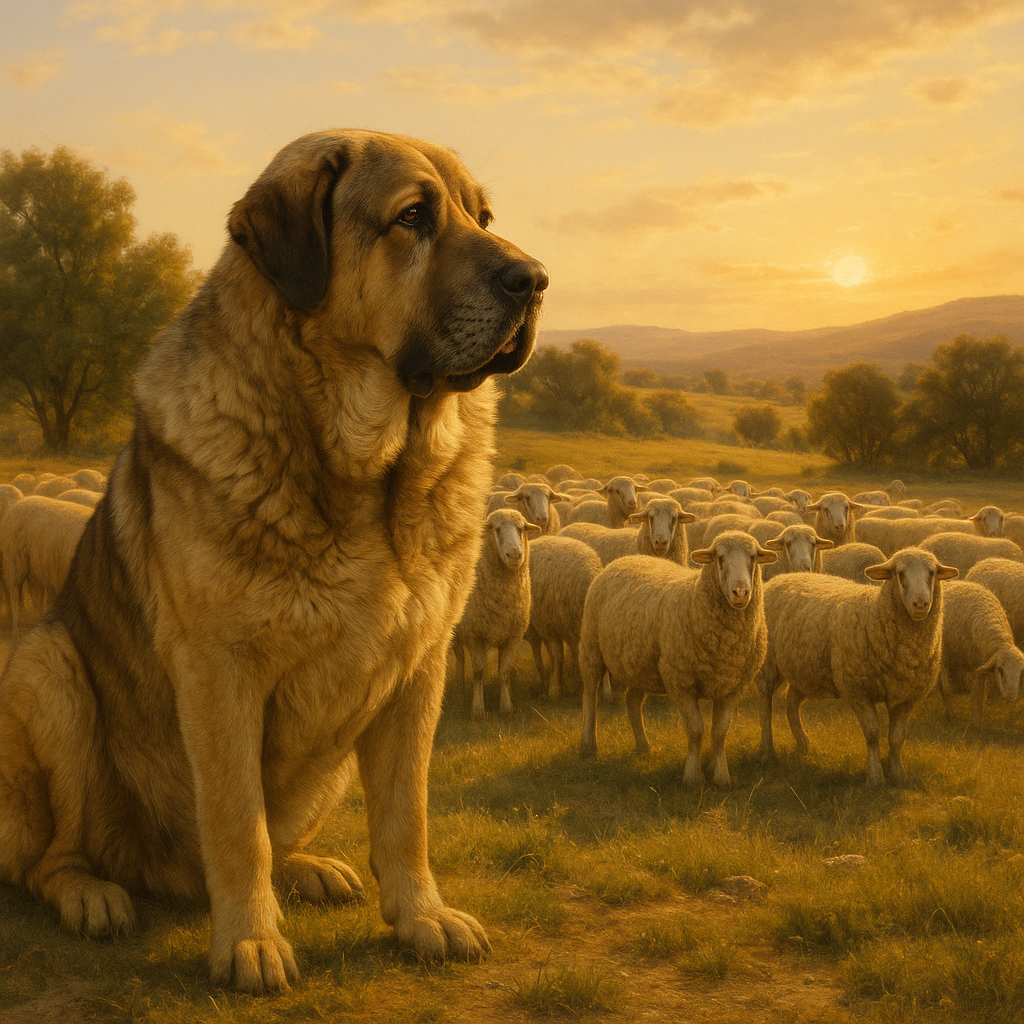
Originating from the mountains and plateaus of Spain, the Spanish Mastiff has shaped itself over the centuries as a tireless protector of herds. Sometimes imposing due to its size, sometimes surprising with its gentleness, this ancestral guard dog continues to fascinate breeders and lovers of rustic breeds.
In brief
🛡️ Spanish Mastín: an age-old guard dog, selected for its vigilance and attachment to the herd.
🐑 Average weight of 50 to 65 kg, powerful bone structure and dense coat perfectly adapted to Iberian winters.
👨🌾 Independent nature, but unfailing loyalty towards its breeder and the animals under its protection.
💡 Care: early socialization, regular exercise, and veterinary control to prevent joint disorders.
Origins and heritage
Long before the Spanish alpine pastures were populated with sheep, robust dogs already roamed these arid lands. Ancestors of the Spanish Mastiff, probably resulting from crosses between imported molossers and local canine populations, they evolved to face predators and harsh climates. In the shadow of Iberian shepherds, these dogs saw a symbiotic relationship born and flourish where mutual trust was the golden rule.
Appearance and physical standards
Imposing without being excessively massive, the Spanish Mastiff stands out with a well-proportioned build and a broad, almost square head. Its coat, mostly light to dark fawn, sometimes displays shades of gray, black, or brindle, depending on the lineages. A thick undercoat enhances its resistance to bad weather.
| Characteristic | Male | Female |
|---|---|---|
| Height at withers | 70–75 cm | 65–70 cm |
| Average weight | 55–65 kg | 50–60 kg |
| Life expectancy | 10–12 years | |
Temperament and behavior
Marked by a subtle duality, the Spanish Mastiff combines inner calm and defensive instinct. Facing a herd, its gaze softens and its step becomes measured. At the approach of a predator, muscles and growl tense instantly. This behavioral flexibility results from centuries of natural selection and human collaboration.
Relationship with the herd
Without ever confusing authority and aggressiveness, it positions itself apart from the beasts, watching for any suspicious movement. Its confidence is expressed through a deep bark, rarely without reason. Lambs eventually identify it as a protector, spontaneously seeking its presence during transhumances.
With the human family
Domestically, this mastín shows unwavering loyalty. Whether a cheeky child or an unexpected visitor, it remains courteous, provided it has benefited from proper socialization. Its imposing size allows for gentle contact: the softness of a caress often suffices to calm its excitement.
Training and Socialization
Like an energetic teenager, the Spanish Mastiff requires a clear framework from a young age. Short, frequent sessions focused on reward and consistency will be more effective than a coercive approach.
- Gradually introduce different environments (city, countryside, markets).
- Positive encounters with other dogs and humans.
- Recall exercises in a fenced area.
- Mental stimulation through tracking games or light obstacles.
Health and Longevity
Like many large breeds, it can suffer from hip/elbow dysplasia and gastric torsions. Sudden death? Rare, if weight and activity are monitored. A balanced diet, sometimes enriched with joint supplements, helps preserve mobility and tone up to 10–12 years.
Adapting to the Environment
Ultimately, the Spanish Mastiff is as comfortable in high altitude as in the plains. Moreover, its thick coat poorly tolerates tropical climates: vigilance is required if you live in the tropics, where shade and fresh water become its best allies.
Comparison with Other Breeds
“The Spanish Mastiff, more measured than its cousin the Pyrenean Mastiff, prefers discretion to noise.” – testimony of an Andalusian breeder
Compared to the Great Pyrenees, it often proves less demonstrative but more enduring. Compared to the Anatolian Shepherd, its size may seem more massive, giving it an even more impressive presence.
FAQ
What is the ideal size of an enclosure for a Spanish Mastiff?
A minimum fenced hectare allows combining freedom of movement and safety, especially if the herd occupies the space complementarily.
Can the breed tolerate apartment living?
In theory, yes if outdoor activity is substantial, but its natural vigilance and size make this option not very advisable.
At what age does socialization begin?
From 8 weeks, during the first leash outings, to associate each new experience with a positive emotion.
How to prevent gastric torsion?
Splitting meals, avoiding intense exercise before and after, and favoring an anti-gulp bowl are simple and effective measures.