The Flat-Coated Retriever fascinates with its intact joy and always sparkling gaze, as if time had stopped at the era when it still bounded across the British moors. More than just a companion, it embodies the joy of living in canine form, capable of keeping its puppy soul well beyond its physical growth. Let’s dive together into the world of this dog with a generous heart, whose energy and gentleness can win over even the most reluctant.
🐾 Origin around 1870 in England, the result of crosses between waterfowl and hunting dogs, designed for endurance.
🎯 Playful and insatiable temperament, always ready to fetch a toy or dive into the water, it requires stimulation and regular outings.
🏠 Ideal for active households, able to adapt to families with children, but unhappy with prolonged inactivity.
💡 Some health benchmarks: life expectancy of 10 to 12 years, sensitivity to dysplasias, and need for daily exercise.
At the roots of a waterfowl hunting dog
Originating from Sussex county, the first Flat-Coated Retrievers navigated the marshes, tracking ducks and pheasants for their masters. However, rather than focusing on the rigidity of a standard, these dogs quickly charmed for their fluid elegance and fine muzzle, highlighting the silhouette of an athlete. Like the evolution of running, where lightness and endurance are now favored, breeding has refined its lines while preserving its tireless temperament.
Genealogy in a playful light
In the 19th century, the Landseer couple mixed the best lines of water and field dogs, seeking a balance between robustness and liveliness. Unlike some curly-coated retrievers, the smooth and dense coat of the Flat-Coated echoes its aquatic vocation. Each generation has preserved this great facial expressiveness, inherited as much from the Lab as from the Setter, for a final result where nothing is left to chance.
Body and bearing: grace in motion
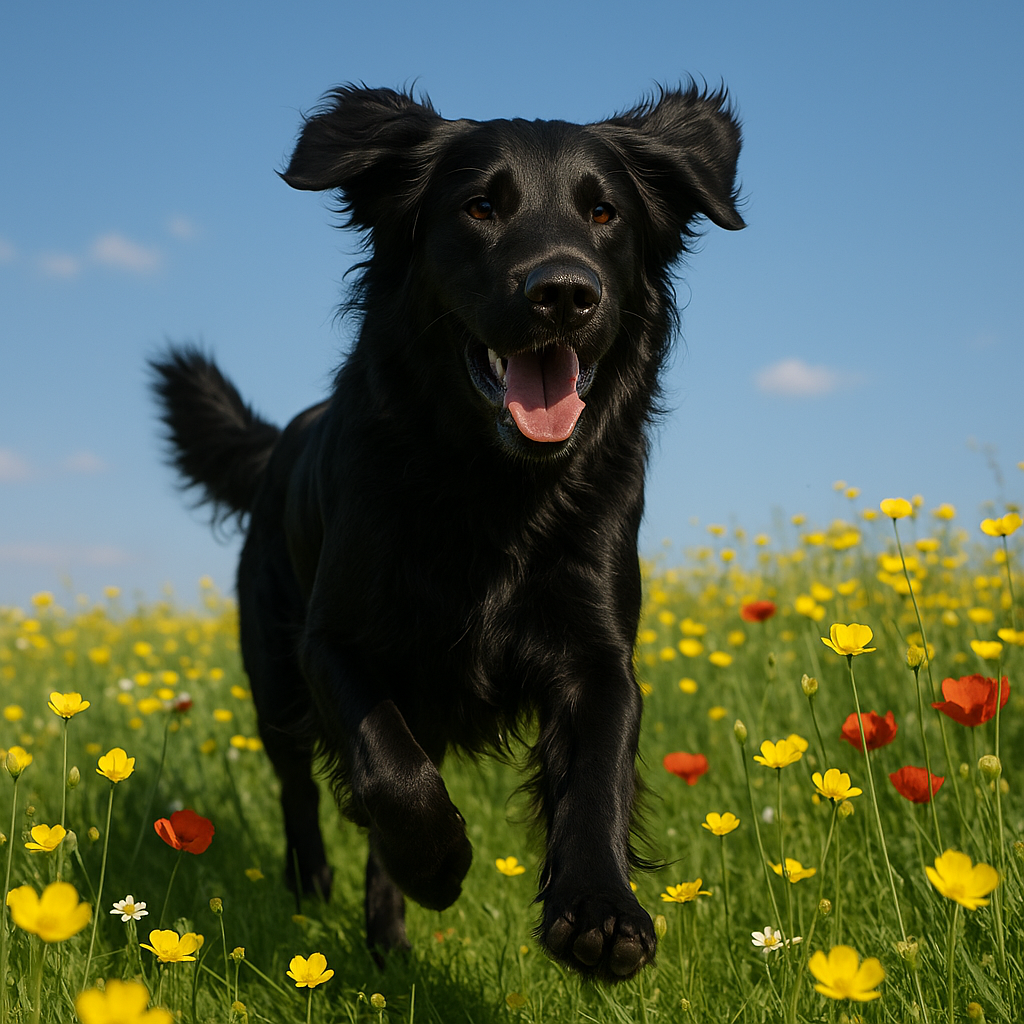
This dog imposes an upright posture, coordinated limbs, and a tail often described as a true “whip of happiness.” The coat, either deep black or warm brown, does not fear bad weather: it dries quickly and naturally repels dirt. When it runs, one likes to say it “glides” rather than trots, offering an almost feline silhouette, scrawny to some eyes, but assured by a well-developed respiratory chest.
A temperament of perpetual adolescence
Forget the expression “calm adult dog”: with the Flat-Coated, it’s pleasure and discoveries all the time. It only takes a butterfly, a stick, or a ripple to trigger frolics and enthusiastic encouragements. Even at 8 years old, it can satisfy a ball throw two kilometers from home, before coming back, tongue hanging out, ready for a cuddle.
Socialization and Complicity
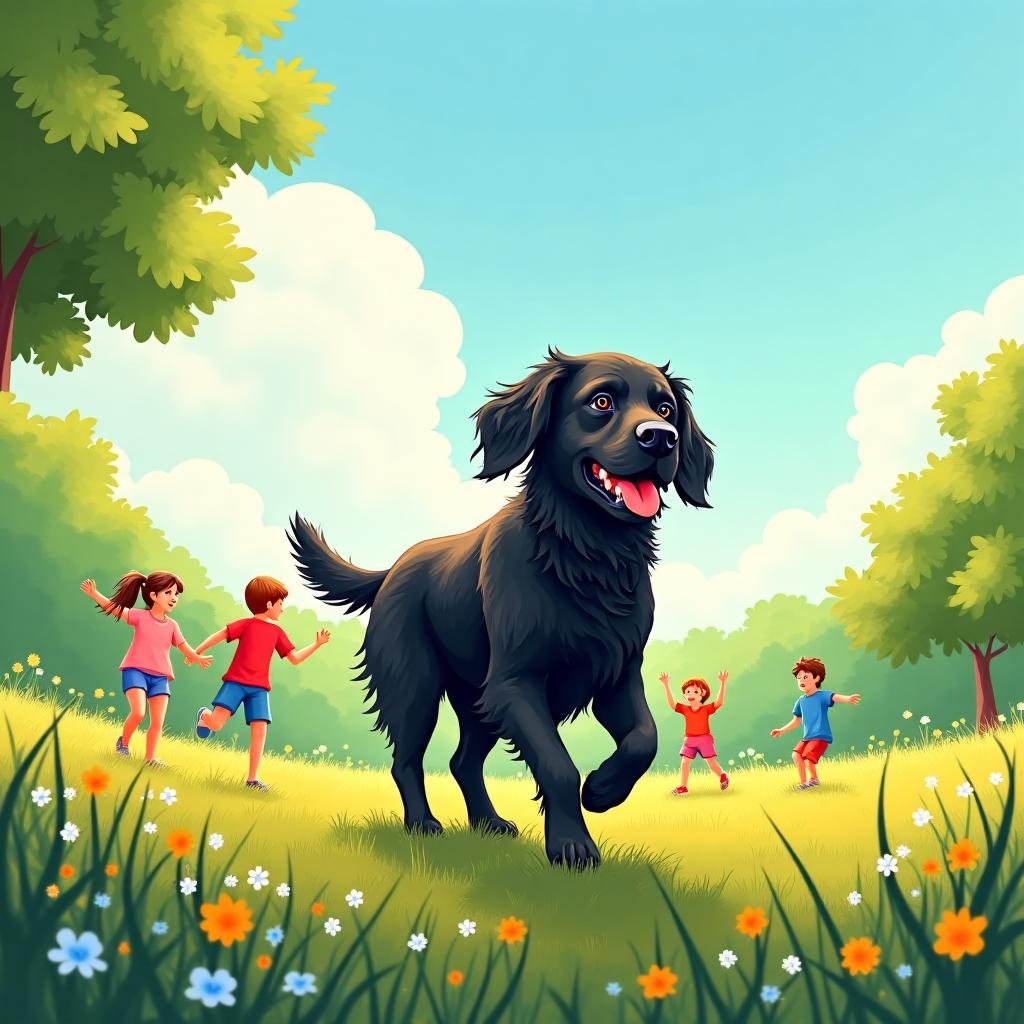
While most breeds are cautious around strangers, the Flat-Coated Retriever displays irresistible enthusiasm. Its sociability often extends beyond the canine sphere: children, elders, cats, or rabbits, everyone becomes a potential playmate. However, this same curiosity can lead it to stray from the path: a well-established recall and regular outings in varied environments are the best defenses against impromptu escapes.
Exercise and Mental Stimulation
To remain balanced, this dog demands a mix of physical and intellectual activities. Fetching a ball, swimming, participating in agility… each new discipline stimulates it. On the mental side, nothing beats scent games, canine puzzles, or playful trick training. Even a simple indoor obstacle course can awaken its sense of reflection, provided it is designed as a challenge.
Care and Prevention: Ensuring Longevity
| Area | Frequency | Practical Advice |
|---|---|---|
| Grooming | 2 times/week | Steel comb to remove dead hairs |
| Physical activities | 1-2h/day | Alternating walking, running, and water games |
| Veterinary visit | Once a year | Check hips, elbows, heart, and eyes |
| Feeding | Meals twice a day | Premium kibble or balanced homemade meals |
Health and Monitoring
The average life expectancy ranges between 10 and 12 years, sometimes more if the hips remain strong and the heart preserved. Tests for dysplasia and degenerative myelopathy have become essential for the serious breeder. As a bonus, regular brushing of teeth and ears prevents ear infections and tartar, thus extending moments of complicity without pain or discomfort.
Training and Education: Channeling Without Restricting
This dog learns quickly, especially when it associates effort with a reward or a game. Its sensitivity requires a gentle tone, but lack of discipline risks losing it: it is better to impose a clear framework from an early age. Short sessions, punctuated with praise and healthy treats, support motivation and strengthen the bond. Never forget that it senses its owner’s mood: patience and consistency combine for successful learning.
“With him, you don’t just learn commands; you discover a new facet of his mischievous personality every day.”
Family Life and Ideal Environment
Affectionate and caring, it adapts to different living environments, provided it is offered a porch to explore or a garden to wag its tail in. In a lively apartment, it will also find its place if walks and moments of complicity are multiplied. Active families with children will be delighted: an unfailing playmate, capable of great displays of tenderness.
Frequently Asked Questions
What is the ideal age to adopt a Flat-Coated Retriever?
Between 8 and 12 weeks, when weaning is complete and the first socialization foundations have been laid. Before this age, the puppy risks having emotional or behavioral gaps.
Can a Flat-Coated Retriever be left alone all day?
Better to avoid it: this highly sociable companion quickly suffers from isolation. If it must stay alone, provide treat-dispensing toys, a comfortable bed, and ideally, an intermediate outing.
How to keep a Flat-Coated Retriever occupied when the weather is bad?
Thinking games (canine puzzles), hiding treats, or a mini indoor agility course are perfect to engage both its muscles and brain.