
The Golden Retriever fascinates with its gentleness and intelligence: an ideal companion for families, it also stands out in assistance and rescue missions. Loyal, playful, and sociable, this British dog nonetheless remains demanding in terms of care and attention. This detailed profile guides you step by step, from the history of the breed to the arrival of your future four-legged companion.
🐕 Origins and popularity: Created in the 19th century in Scotland, the Golden Retriever was designed for hunting, but its gentle character quickly propelled it to the status of a preferred family dog. This is evidenced by its qualifications as a guide dog and avalanche rescuer.
✂️ Coat care: Thick and water-repellent, the Golden’s coat requires regular brushing (at least twice a week) to avoid knots and mats, and occasional bathing to preserve its natural oils.
🏃 Daily exercise: Very active, it needs 45 to 60 minutes of physical activity per day (games, walks, swimming) to channel its energy and develop its intelligence through playful solutions.
🩺 Life expectancy and health: Expect between 10 and 12 years for this breed, often prone to hip dysplasia and certain heart diseases: regular veterinary follow-up is essential.
Origins and history
Like other British spaniels, the Golden Retriever owes its existence to Lord Tweedmouth, passionate about hunting and animal breeding. In the mid-19th century, he crossed a yellow Retriever with a Tweed Water Spaniel (now extinct), seeking a dog capable of retrieving game and poultry from both land and water. The result: a versatile breed, quick to learn and gentle with the whole household.
Over the decades, the Golden Retriever won the hearts of American families, attracted by its golden coat and ease of training. Official canine clubs recognized the breed in 1913, then exported it worldwide, where it remains one of the most popular.
Physical characteristics
General appearance
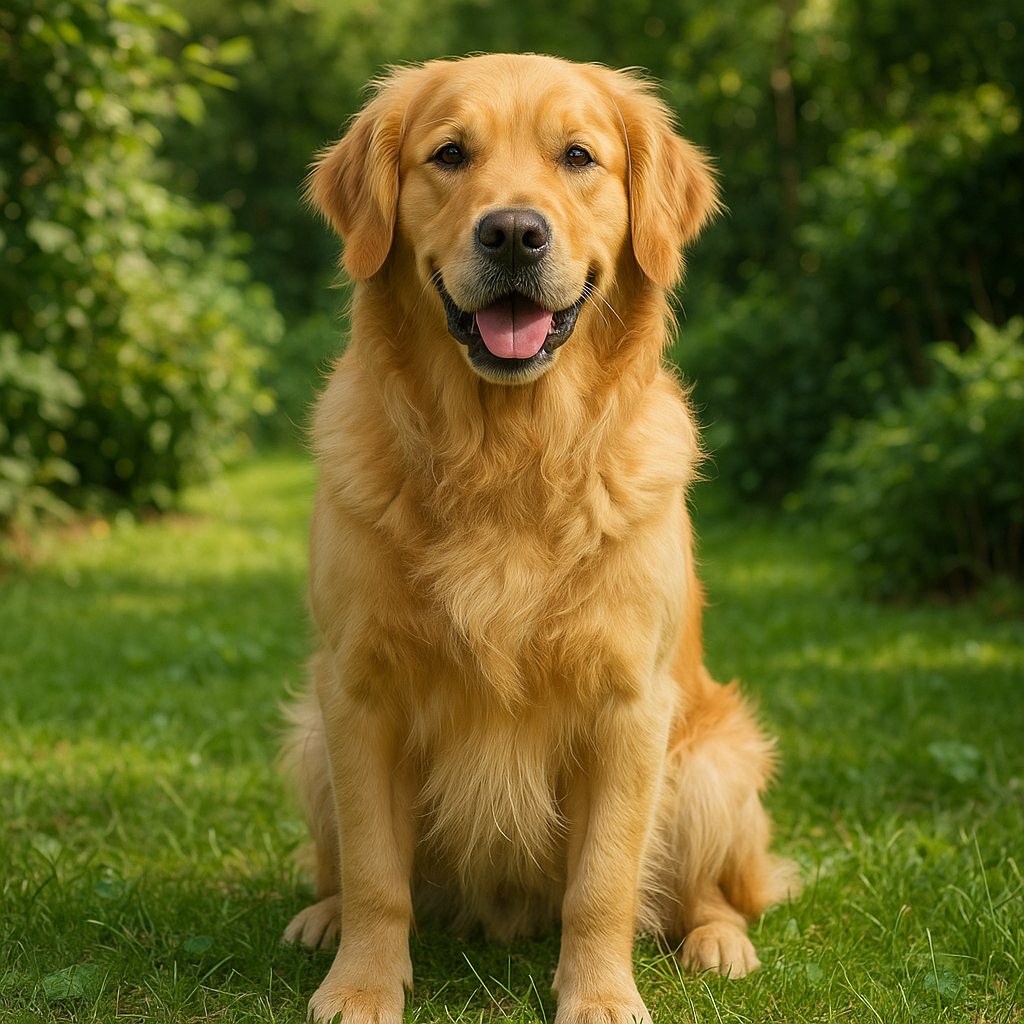
This medium-sized dog impresses with its elegant carriage and harmonious musculature. Its skull is broad, its gentle and expressive eyes display a hazel or dark brown shade, and its drooping ears frame a lively and friendly gaze.
Measurement table
| Height at withers | Weight | Colors | |
|---|---|---|---|
| Male | 56 – 61 cm | 29 – 34 kg | Pale gold to dark golden |
| Female | 51 – 56 cm | 25 – 29 kg | Light gold to intense golden |
Coat and colors
The coat, dense and waterproof, consists of a smooth outer layer and a softer undercoat. The feathering (longer hairs) appears on the chest, behind the legs, and under the tail, providing a flowing look in motion. The shades range from ivory to coppery golden; very dark hues are less recommended in the standard.
Temperament and Behavior
Intelligence and sociability combine in the Golden: it forms a strong bond with each member of the household, whether children, other dogs, or adults. Patience and tolerance make it a tireless play partner, provided stimulating activities are offered.
- Extroverted: enjoys human presence and hates prolonged solitude.
- Playful: loves fetch games (frisbee, ball) and swimming.
- Obedient: quickly responds to commands when training is based on reward.
- Sensitive: reacts poorly to harsh corrections, prefers gentle verbalization and positive reinforcement.
Education and Training
The key lies in consistency and gradual progress. Starting training as soon as the puppy arrives (from 8 weeks) helps establish good habits before adolescence, a period of canine turbulence and recklessness.
Recommended Methods
- Positive reinforcement: treats, petting, and games for each achievement.
- Early socialization: encounters with different environments, noises, and people up to 4 months.
- Gradual exercises: leash walks, recall at a distance, then in varied situations.
“The Golden Retriever learns mainly through motivation: making each session playful ensures rapid and lasting progress.” – Canine ethology advisor
Care and Maintenance
Brushing and Grooming
Brushing its coat two to three times a week prevents the formation of knots and mats, especially after each winter outing. Using a soft-bristle brush followed by a metal comb helps remove dead undercoat without damaging the skin. Bathing should be occasional to avoid removing protective oils.
Health and Life Expectancy
Despite remarkable vitality, the Golden Retriever remains susceptible to certain ailments: hip and elbow dysplasia, cardiomyopathy, tumors, and hypothyroidism. An annual veterinary check-up including joint X-rays and heart auscultation is strongly recommended from 5 years old.

Nutrition
A balanced diet, rich in quality proteins and omega-3 fatty acids, supports joint health and coat beauty. Daily quantities: about 2 to 3% of body weight, divided into two meals. Adjust the ration according to age and activity, reserving treats to a strict minimum.
Physical Activity and Play
This sporty dog requires daily engagement: jogging, swimming, or tracking workshops. Intelligence games, such as canine puzzles, satisfy its need for mental stimulation. Boredom can lead to destruction or excessive barking.
Choosing a Puppy
Favor a recognized breeder where each litter is screened for dysplasia, and ensure socialization begins from the first weeks. Observing the behavior of siblings, the puppy’s curiosity, and its interaction with the mother often predicts its adult temperament.
FAQ
What is the average lifespan of a Golden Retriever ?
Between 10 and 12 years on average, depending on genetics and quality of care.
At what age does it start to bite ?
The biting phase begins around 3 months and generally decreases after 6 months if provided with chew toys and appropriate training.
How to prevent hip dysplasia ?
Moderate exercise during growth, balanced diet, and early screening ultrasounds at the breeder before adoption.