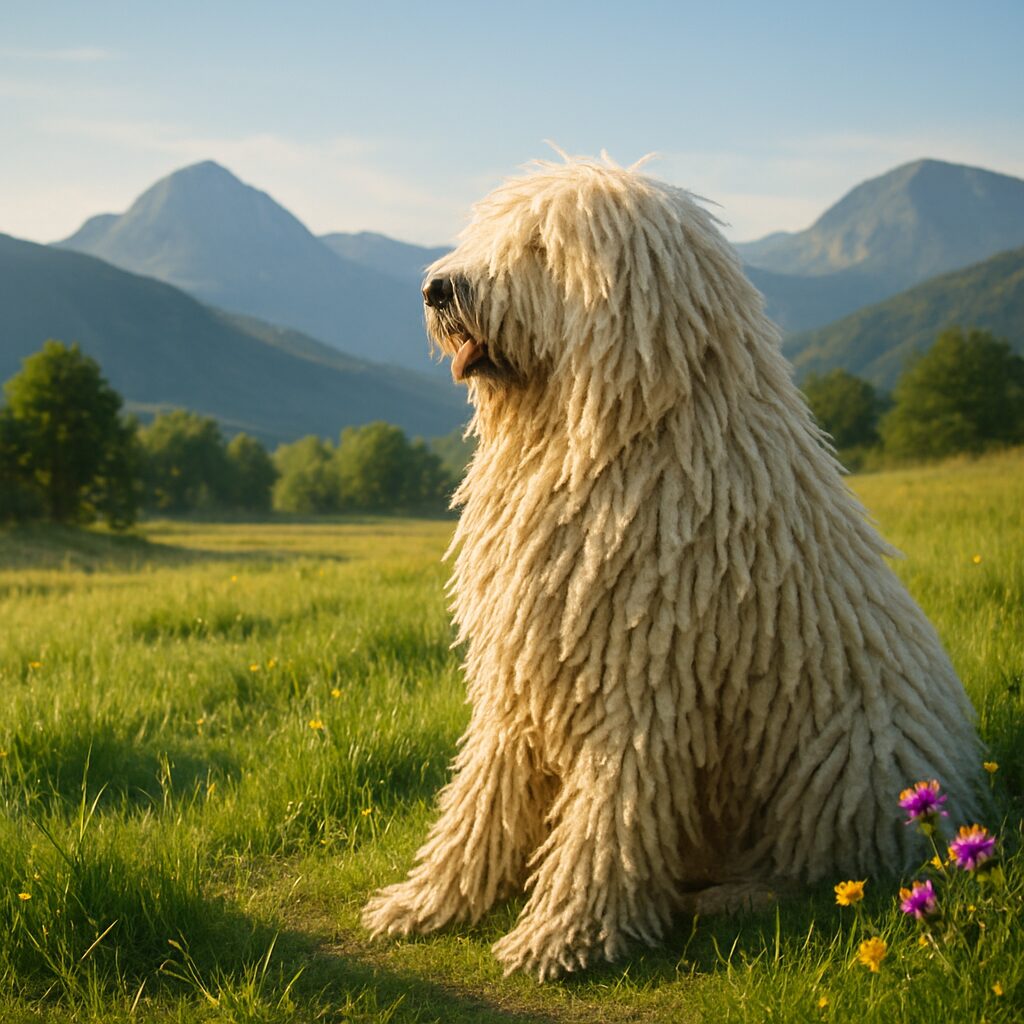
The Komondor, nicknamed the “mop dog” for its entirely corded coat, is a large guardian from the Hungarian plains. It is imagined as placid and unkempt, but its protective instinct is sharp, its presence deterrent, and its attachment to its home strong. If you are looking for a companion who is both rustic, independent, and loyal, capable of securing a property while remaining gentle with its family, this guide gives you the keys to understand its temperament, succeed in its training, maintain its unique coat, and offer it a balanced life.
🔎 Profile — Large livestock guardian dog, white corded coat, independent but loyal character. Better suited to a house with a garden than to an apartment.
🧠 Training — Early socialization, clear rules, short and consistent sessions. Keep the watchfulness instinct under control through recall work and self-control exercises.
🧴 Grooming — Separate the cords, dry thoroughly, do not brush. Monitor skin, moisture, and parasites. Maintenance time: 30–60 min/week.
❤️ Health — Large build: screening for hip dysplasia, joint care, weight management. Good life expectancy for a large dog: 10–12 years on average.
Origins and protective role
A historic guardian of the Hungarian plains
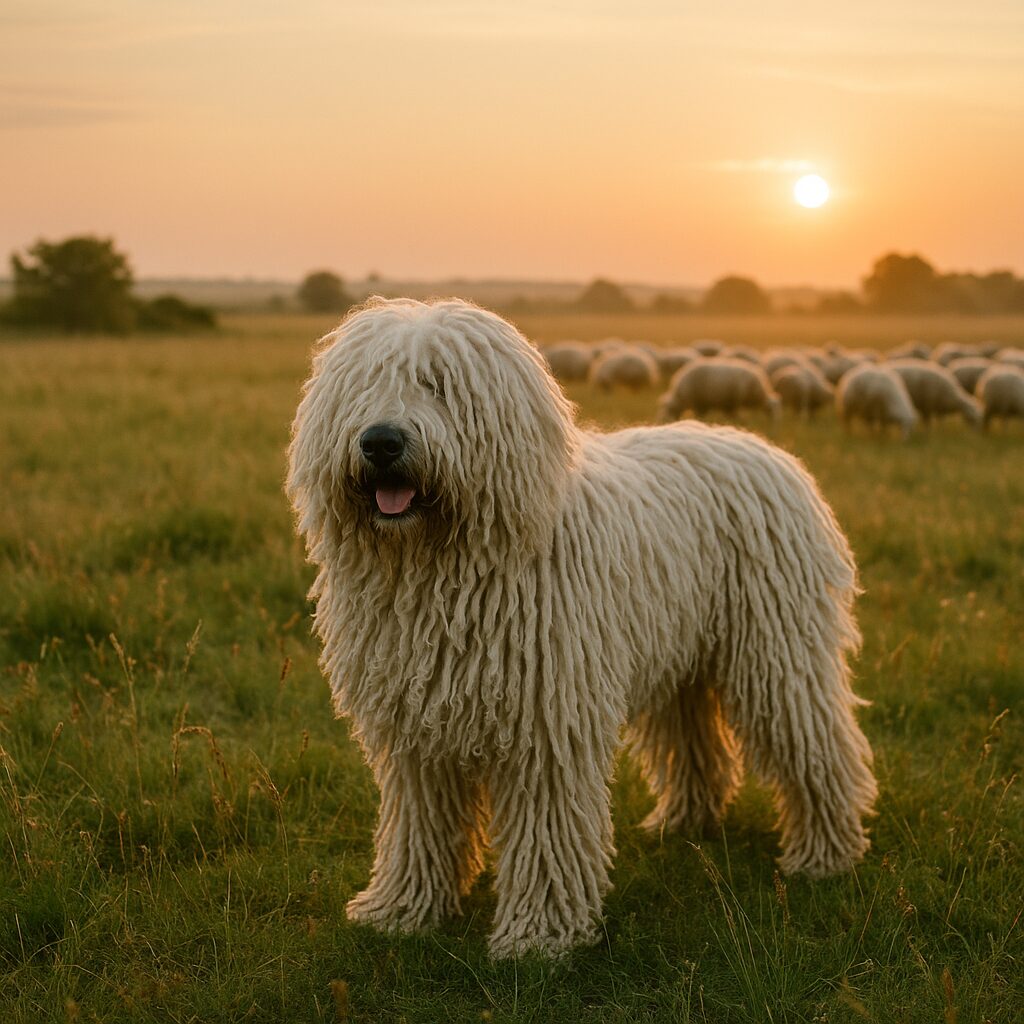
The Komondor belongs to the Hungarian shepherd dogs specialized in livestock guarding. Its historic mission: live among the animals, deter predators, and intervene if necessary. According to the FCI, standard no. 53 (2016), the breed is large, powerful, able to withstand bad weather, with a white coat to blend in with the flock. This selection has forged an independent temperament, attentive to everything moving in its territory, but remarkably stable when it understands its living environment.
Why this unique corded coat?
It is often believed that the “mop” coat is just an aesthetic whim. In reality, these cords form a mechanical barrier against cold, rain, and originally, against bites. The dense texture protects the skin and reduces the impact of scratches. This hair structure, similar to a braid, is not brushed: it is separated and maintained. It is a specificity that requires method, but offers real comfort to the dog when well managed.
“Livestock guardian breeds are primarily deterrents: they prevent intrusion by occupying space, barking in a targeted way, and positioning themselves between the threat and the flock. Emotional stability and socialization are more decisive than brute strength.”
UC Davis Veterinary Medicine – Livestock Guardian Dogs Program – 2016
Morphology and Corded Coat: Understanding and Maintenance
Size, Proportions, and Appearance
The Komondor is a large dog: males often over 70 cm, females a bit lighter. Strong bone structure, deep chest, solid backline. The gait is supple, almost feline, with a massive head and dark eyes. Its silhouette is sometimes more guessed than seen, so much does the corded coat create a unique volume. This contrast — calm mass and fluid mobility — sums up its identity as a placid but attentive guardian.
Grooming: The Protocol That Changes Everything
No brush, few scissors: the heart of maintenance lies in separating the cords by hand, especially in areas that rub (ears, armpits, flanks, base of the tail). Bathing is possible, but a complete drying must be planned to avoid trapped moisture and skin problems. Many owners develop a weekly ritual of 30 to 60 minutes: inspection, separation, targeted drying if needed. A hairdryer at moderate temperature and microfiber towels make the difference.
“A corded coat requires a routine: regularly separate, rinse without excess products, dry thoroughly. Residual moisture promotes irritations and odors. When done well, the method protects the skin and preserves the characteristic appearance.”
AKC – Breed Education & Grooming Notes – 2024
Temperament, Socialization, and Family Life
An Independent Dog Sensitive to Structure
The Komondor combines protective instinct and attachment to home. It is not a dog of “orders” in the strict sense: it thinks, evaluates, chooses. This is not stubbornness, it is the heritage of the herding guard dog who works without a direct handler. In a family environment, it shows itself to be gentle and patient, especially if given clear routines, a readable territory, and if its signals are respected. Outdoors, it may bark at stimuli it judges atypical; socialization works precisely on this perception.
Socialization: Critical Window and Best Practices
Between 3 and 14 weeks, the puppy’s brain encodes its “normalities.” Exposing a young Komondor to varied humans, polite dogs, and contrasting environments creates a more stable adult. According to the AVSAB (2018), early, safe, and gradual socialization reduces the risk of fear and aggression related to the unknown. With a large guardian, prioritize quality, short, supervised encounters, and reinforce calm behaviors on command.
“Socialization conducted early, with positive and controlled experiences, significantly reduces behavioral problems in adulthood. The priority is safety and gradualness, not the quantity of exposures at all costs.”
AVSAB – Position Statement on Puppy Socialization – 2018
One might think a Komondor is incompatible with children. In reality, well socialized and properly supervised, it shows itself protective and gentle. Cohabitation with unknown adult dogs requires discernment: favor stable individuals, meetings on neutral ground, and a reliable recall. If your goal is monitoring difficult terrain, some families compare with more “offensive” profiles like a Caucasian molossus; the Komondor, however, remains primarily a calm territorial deterrent.
Education and exercises: setting boundaries without breaking
Clear rules, short sessions
A Komondor quickly understands what makes sense. Work on recall, basic positions, attentive walking, and self-control (waiting, leaving). Sessions of 5–10 minutes, varied, ending on a success, are better than long repetitions. Discreet food rewards, petting, calm voice: we want a calm dog who chooses the right behavior. Harsh punishments are counterproductive and damage the relationship.
Daily exercise, but smart
It is neither a marathon runner nor a park “sprinter.” It enjoys regular walks, scent games, and watching over a well-fenced garden. Avoid repeated jumps during adolescence to protect the joints. Environmental enrichment (scent caches, objects to move, small tasks) channels the mental energy of the guard dog. In other words: a relevant activity is better than empty expenditure.
- Recall 3 times/week: train on a long line, reward spontaneous return.
- Daily self-control: “wait,” “leave it,” controlled releases.
- Regular socialization: short meetings, stable dogs, varied contexts.
- Scent work: snuffle mats, simple trails, 10 minutes focused.
- Quality rest: quiet zones, rituals, respecting signals.
Health, nutrition and targeted care
Veterinary watch points
Being a large breed: hip and elbow dysplasia are among the recommended screenings. The OFA (2023) reminds of the interest in selection X-rays and weight control to limit joint strain. Also watch for: skin (maceration under wet cords), ears (ventilation), and gastric torsion as in other large dogs, by splitting meals and avoiding intense activity after eating.
Nutrition and ideal weight
Following a ration adapted to life stage and activity level avoids many troubles. The guidelines of the WSAVA (2019) encourage monitoring a stable Body Condition Score, progressive food transition, and regular evaluation with a veterinarian. Quality complete kibble, or home-cooked ration formulated with a professional, the essential remains consistency, balance, and prevention of weight gain.
Weekly grooming ritual
The most effective method is simple but demanding: inspection of the body, gentle separation of the cords, targeted ventilation and drying if moisture sets in. In rainy periods, baths are spaced out, sparing rinses are favored, and drying is done thoroughly. Products must be sober: a gentle shampoo, diluted, rinsed thoroughly, then patience. The result: a healthy coat, less odor, and a comfortable dog.

Komondor vs other protection dogs
Compare to choose wisely
Overall, the Komondor is neither the easiest nor the most difficult of protection dogs. It lies between very massive profiles focused on frontal deterrence and more compact and lively dogs. A comparative overview helps clarify the size, coat, and expected use.
| Breed | Height (cm) | Weight (kg) | Coat / Role |
|---|---|---|---|
| Komondor | 65–80 | 40–60 | Corded white coat; herd guard, calm deterrence |
| Puli | 38–45 | 10–15 | Also corded, more agile; driving and alert |
| Caucasian Shepherd | 64–76 | 50–90+ | Dense, non-corded; defense and close protection |
“Choosing a protection dog first requires evaluating the environment and management capacity: fences, neighborhood, frequent stimuli. The trust relationship and training in bark control are crucial for harmonious coexistence.”
Hsu & Serpell – C-BARQ, University of Pennsylvania – 2003
Quick verdict, pros/cons and method
Verdict at a glance
Overall rating: 8.5/10. Recommended for: households in a house with enclosed space, patient and consistent profiles, seeking a deterrent guardian who is both gentle and self-controlled. To avoid if you live in an apartment without dedicated time for socialization and maintenance of the corded coat.
What we liked / liked less
- Likes: stability, loyalty, calm deterrence, low need for intense exercise, unique look.
- Dislikes: technical grooming, long drying, demanding socialization, neighbors sometimes sensitive to barking.
Methodology of this guide
Grid based on official standards (FCI, AKC), veterinary recommendations (OFA for screenings, WSAVA for nutrition) and canine behavior literature (C-BARQ/University of Pennsylvania; AVSAB position on socialization). Criteria: temperament, family adaptation, maintenance, health, training, environment, cost and availability. Limitations: individual variability, working/companion lines, life context.
Practical recommendation
If you appreciate a large calm dog, a guardian without ostentation, ready to live at the pace of the family and garden, the Komondor will suit you. Choose a breeder who performs screenings (hips/elbows), validates the character of the parents, and supports grooming. Next step: meet a well-balanced adult, observe the coat and discuss maintenance at length.
Practical tips for success
“Cord” maintenance routine in 4 steps
- Inspection: check warm areas (ears, armpits, flanks, tail).
- Separation: gently open the cords with fingers, never use a brush.
- Evacuation: squeeze the cords like a sponge after bath or rain.
- Drying: warm airflow, long, down to the core of the cord.
Errors to avoid
- Too frequent baths: promote trapped moisture.
- Sloppy drying: leads to irritations and odors.
- Late socialization: reinforces barking at strangers.
- High-impact exercises: to be limited in young dogs.
Useful sources and landmarks
Clinical and standard references
According to the FCI (Standard No. 53, 2016), the coat must be white, a corded texture is sought after, and the guarding function guides the selection. The AKC (2024) specifies best practices for maintaining a corded coat. The OFA (2023) recommends X-rays and reasonable selection to limit dysplasia. The WSAVA (2019) proposes a Body Condition Score grid to maintain ideal weight. The AVSAB (2018) reminds of the socialization window from 3–14 weeks.
FAQ
Is the Komondor suitable for apartment living?
Possible, but far from ideal. It is a large guard dog that benefits from a fenced garden to watch over and rest. In an apartment, it will be necessary to compensate with calm outings, scent work, and careful management of barking.
Should the corded coat be brushed?
No. A corded coat is not brushed. The cords are separated manually, rinsed moderately, then dried thoroughly. Brushing would break the structure and cause a woolly appearance and knots that are difficult to fix.
Is it compatible with children?
Yes, if socialization has been well conducted and interactions are supervised. The Komondor is generally gentle and tolerant, but its size requires safety rules shared by everyone, children and adults alike.
How much time for weekly maintenance?
Allow 30 to 60 minutes per week for inspection and separation of the cords. After a bath, drying can take longer. Regularity significantly reduces the overall workload.
What pathologies should be monitored?
Large breeds are exposed to hip/elbow dysplasia; screening is recommended. Also monitor the skin (humidity), ears, and prevention of gastric torsion through fractioned meals and post-meal rest.
What type of exercise should be favored?
Daily walks, scent games, garden observation. Avoid repeated jumps during adolescence. Focus on calm and “useful” activities that respect its nature as a guardian.
Is the Komondor noisy?
It may bark to signal a presence, that is its role. Work on the quiet command, enrich the environment, and structure activity slots to limit excessive alertness, especially in urban areas.
What diet to choose?
A complete quality kibble or a homemade ration formulated with a veterinarian. Follow WSAVA guidelines for the Body Condition Score and adjust according to activity and age.
At what age do the cords form?
In the young dog, the woolly texture gradually develops and the cords form around 8–12 months. Manual separation guides the size and regularity of the locks.
Can a Komondor live with other animals?
Yes, especially if cohabitation starts young and is structured. Gradual introductions, resource management, and calm rituals promote lasting harmony.
Conclusion
The Komondor has a thoughtful guardian temperament, wrapped in a unique coat. In a family with clear boundaries, willing to maintain its cords and invest in careful socialization, it offers a calming and protective presence. The roadmap is simple: screenings, a serious breeder, maintenance routine, calm exercises. Then, let it do what it knows best: watch over its own, without fuss.